Showing posts with label writing. Show all posts

Saturday, February 7, 2009

25 random things about me

Now that the 25-random-things rage on Facebook is about spent, it's about time I got in on it. Here's what I just posted.

1. I keep bees. That usually starts a conversation.

2. The TNJN.com kids make me look like a wizard and a genius every day. I am in awe of them. I wouldn't dare tell them that, however.

3. I love choral music. I'm also a big fan of baroque, bluegrass and fusion jazz.

4. If I am still in bed at 5 a.m., that means I have overslept.

5. My wonderful wife Sally and I discovered gardening after we moved to East Tennessee a few years ago. We have had great fun doing that together.

6. On Tuesdays, Thursdays and Saturdays, I prefer watercolor over pen and ink. On Mondays, Wednesdays and Fridays, I prefer pen and ink over watercolor. On Sundays, I can't decide.

7. When I was in the first grade, my mother wrote a note to my teacher excusing me from class as lunch because it was the first day of the World Series. This was in 1954, and the Series was still played in the afternoon then. I came home and watched the game. That was the game when Willie Mays made The Catch. I don't remember seeing it.

8. The three best reasons for being in education are May, June and July.

9. In 2008, I lost 25 pounds, got my first novel published and grew potatoes. I'm glad I didn't have to choose.

10. I once interviewed Billy Graham at his home in Montreat, N.C. When the interview was over, he asked if I needed to go to the bathroom. I didn't, but I said I did. I figured that was the only chance I would ever get to see Billy Graham's bathroom.

11. I believe in the First Amendment. Not many people do.

12. About two and a half years ago, our cat, Squeaky, died. I still think about her a lot.

13. I am a connoisseur of sunrises (see #4).

14. I am a very lucky fellow. (See picture below. See also my Picasaweb albums. )



15. In 1970, I was one of the very last people in the U. S. to receive a draft notice. I spent four years on active duty in the Navy.

16. Writing for the Mass Media, one of the textbooks I have written, is now in its seventh edition. The book is 25 years old. That's older than most of my students.

17. I once met Bear Bryant. I have a story about that.

18. I have worked for newspapers in five different cities: Bristol, Knoxville, Birmingham, Tuscaloosa, and Chicago. Technically, it's six cities. Does anybody know why?

19. I own two Miatas. One is red. The other is green. Long story.

20. My favorite joke is the one about the kid who gets his grade report at the end of the term and has all Fs, except for one D. He thinks about it and come to the conclusion that he has been concentrating too much in one subject.

21. I created a web site called JPROF.com and also do blogs called The Writing Wright and Honey Dot Comb. Sally came up with that last name, but she denies it.

22. I have one rule of civil behavior for all of my classes, large and small. It's a rule I impose on myself, not on my students. The rule is: If you're talking, I'll listen.

23. Football, basketball and hockey are minor, off-season sports invented to take up the space between the end of the World Series and Opening Day.

24. I grew up in Nashville. That's significant.

25. Writing is one of the most important things that we do.

This was a good exercise, and it was fun.

Sunday, December 14, 2008

Lincoln at 200; Lincoln the writer


Once Americans get through Christmas, they will be faced with two important dates that inter-weave themselves politically and historically: the inauguration of Barack Obama as president of the United States on Jan. 20 and the 200th anniversary of the birth of Abraham Lincoln on Feb. 12.

For the moment, the Writing Wright will set Barack aside and deal with Abraham.

A good place to start our considerations of Lincoln is at the Reading Room of the New York Times, where a few short essays about the 16th president now reside. The essays are written by Ed Rothstein and Charles (Chip) McGrath, and they are drawing some interesting responses through the Times' moderated forum.

When I think of great presidents -- truly great -- I think of three: George Washington, Abraham Lincoln and Franklin Roosevelt. Their greatness, to be fair to other presidents, is not defined by just personal characteristics but also by the times and crises they faced.

Of those three, only Lincoln produced any significant amount of important writing. In fact, a new biography, Lincoln: the Biography of a Writer by Fred Kaplan, has recently been published. I have not read the book yet, but getting a copy for Christmas or during post-Christmas shopping is not out of the question. So what's written here will be second-hand comments. At the Times, McGrath devotes one of his essays to Lincoln the writer, and Rothstein also deals with this aspect of Lincoln in "The Literal Powers of Words."

Not only did Lincoln write well, he actually wrote about writing. Rothstein writes:
But look at what Lincoln says in his Lecture on Discoveries and Inventions, delivered in Jacksonville, Ill., in 1859, the year before he was elected President. The lecture is not terribly gripping, but it builds to a climax when it comes to the invention of writing. Lincoln describes what a remarkable innovation writing was, and how much it has advanced the societies that have cultivated it.
So what did he say? Here is an exerpt:
Writing -- the art of communicating thoughts to the mind, through the eye -- is the great invention of the world. Great in the astonishing range of analysis and combination which necessarily underlies the most crude and general conception of it -- great, very great in enabling us to converse with the dead, the absent, and the unborn, at all distances of time and of space; and great, not only in its direct benefits, but greatest help, to all other inventions.

Get ready for lots of Lincoln over the next couple of months.

______

The Writing Wright
Kill the Quarterback
A larger version of the pen and ink drawing of Abraham Lincoln (above) can be found at First Inning Artworks.

Wednesday, December 10, 2008

William Tecumseh Sherman: Marching through the American mind


The Union Army, under the command of William Tecumseh Sherman, decamped from a devastated and burning Atlanta on November 16, 1864 and marched across the expanse of Georgia until it reached Savannah. The purpose, according to its commander, was to bring the horrors of war into the farms, fields, parlors and living rooms of the South in a way that would teach Southerners the futility of continuing the fight for their independence.

The march through Georgia took almost exactly a month. A week before Christmas, Sherman wired President Abraham Lincoln from Savannah, offering him the city as a "Christmas present."

Sherman succeeded far beyond anything that he had in mind at the beginning of his journey.

As Ed Caudill and Paul Ashdown (two of my good friends and colleagues at the University of Tennessee) write in their Sherman's March in Myth and Memory:

The myth of the March and the man gained momentum for the rest of his life. Old soldiers told tales and reminisced, while Sherman lectured and wrote his memoirs. By the time of his death in 1891, the March was a term that meant one march, embodied in one man in American history. Ironically, the "Old South" and "the March" had become intimately linked as thesis and antithesis -- agrarian and industrial, tradition and modernism, spiritual and material. . . .

The memory endured in the South and became a nationsl one, encapsulated in a few seconds from a film now three-quarters of a century old, Gone With the Wind: "And the wind swept through Georgia: Sherman!" in giant letters as the screen goes up in flames.

Caudill and Ashdown's book is the third of three than examine the myths that grew out of prominent Civil War figures. The two earlier books looked at John Singleton Mosby, the Gray Ghost, and Nathan Bedford Forrest. Mosby's accomplishments during the war were relatively minor, but Mosby was literate and wise in the ways in which an image could be formed, and he also had the good fortune to live well into the 20th century. Forrest, more impressive in his military accomplishments than Mosby, was not so fortunate in any respect and is now a historical oddity that fires controversy even at the mention of his name.

Sherman is a towering figure of the war, a man who is mentioned along with Grant, Lincoln and Lee. He lived longer than Forrest and wrote his memoirs, but he never appeared to have much concern for his image -- at least, not as much as Mosby showed. Sherman seemed content to leave his image in the hands of others, especially journalists whom he professed to hate.

I talked with Paul Ashdown about the role journalists played in creating the myths of these men, and asked him if anything about the three-book study surprised him. (Click on the arrow below to being the audio: 3:34):


What happened on the march through Georgia is just one of the mysteries of myth that surround William Tecumseh Sherman. The book by Caudill and Ashdown reveals him to be a fascinating and complex character far beyond the hero or villain that emerged from the road across Georgia.

Each of the books in this series is a shrewd exploration of the way in which memory and myth work in the American culture. They are highly recommended.

See the previous Writing Wright reviews:
______

A larger version of the pen and ink drawing of Sherman (above) can be found at First Inning Artworks.

Saturday, December 6, 2008

Aristotle figured out the storytelling 2,300 years ago

An article in the March issue of The Writer magazine lays out what Aristotle thought about storytelling about 2,300 years ago. The article, written by William Kowalski, points out that the Greeks didn't have the novel, but they did have theater. From that, Aristotle decided to outline what he thought made a compelling story:


  • All stories are made up of five elements: setting, character, plot, dialogue and thought (intentions/motivations).

  • Plot is everything.

  • Characters come second.

  • Keep the audience interested by making reversals.

  • Use discoveries to move the plot.

  • The perfect plot is simple, not complex.
Kowalski adds some excellent commentary to each of these points, including this one:


By the way, was it smooth sailing once our ancient student of writing achieved the goal of all literary hopefuls -- publication, or in the case of dramatists, production? Not quite. "Because there have been poets before him strong in the several species of tragedy, the critics now expect the (writer) to suprass each of his predecessors," Aristotle intones.

In other words, 25 centuries ago, authors were already awaiting their reviews with butterflies in their stomachs. Some things never change.


(The Writer magazine article is not available online.)

Monday, December 1, 2008

Writing Wright reviewed by 'Small Church Pastor'

My old friend Chuck Warnock has written a very nice review of The Writing Wright for his popular blog Confessions of a Small Church Pastor.

Here's part of what Chuck says about the book:
The Writing Wright brims with quotes, anecdotes, excerpts, and illustrations about writers and writing. From Samuel Johnson to Ernest Hemingway to Mark Twain plus about fifty more writers, Stovall packs his compendium with the humorous and helpful for professional and aspiring writers. It’s the kind of book you will pick up again and again just to read it and smile because a writer you like said something interesting. Or funny. Or clever. Or outlandish. But never boring.
I'm honored.

Chuck is doing ground-breaking work in rethinking the role of the small church in the community. While others are trying to figure out how to make small churches into big churches, Chuck is beginning with the premise that growth is what the small church should be about. Instead, it should be able serving the community -- providing something that the community doesn't have from any other institution.


Chuck, who blogs for Outreach magazine, has gained a substantial following for his ideas and his writing. He's an active guy with a fertile mind, and I have had the privilege of knowing him and his wife Debbie since we were all in high school together in Nashville in the mid sixties.

Chuck and I are cooking up a couple of projects to collaborate on, and you will be hearing more about those soon.

Sunday, November 30, 2008

Headlines and titles: the 'invention' conceit

  • In our modern Scots-invented world of bloviation, headlines and titles can't stand the heat of a literalist's kitchen.

  • Note: This is a post that appeared on a previous blog in May. I'll be doing a follow-up soon.
Being a literalist when it comes to words and their usage (though not without a sense of humor, I hope), I tend to pay attention to headlines and titles and to parse them unmercifully.

That's why, when I got my copy of Sports Illustrated last week, I was taken aback by the headline on the cover. (Yes, I get a hard copy of Sports Illustrated. It apparently comes as part of the audio subscription I have with Major League Baseball. I didn't ask for it and wouldn't buy it otherwise. I even turn down the copy of the swimsuit issue, which probably disappoints the editors because they use their highest level of sports knowledge to produce this profound epic. But I digress.)


The headline on this week's issue of SI reads: The Best Game Ever. One of the subhead is "How John Unitas and Raymond Berry Invented the Modern NFL."

I'm no expert, but I know a little bit about the history of professional football in this country. I was alive in 1958 and remember listening to the Giants-Colts game on the radio in my room where I grew up in Nashville, Tenn. (It was on Sunday afternoon, and in my household at that time, we didn't watch television on Sunday.)


True, this was the first of an era of popularity of professional football that still has not run its course. And true, it was a great game with many great players. The stuff of legend, as they say. I don't quarrel with the assertion that it might have been the best game ever.

But really . . . to claim, as the subhead does, that a couple of players "invented" professional football is a bit over the top. It certainly doesn't qualify as being discrete or modest in the use of the language. In fact, it goes too far in the other direction by being splashy and overblow -- and by ultimately being wrong.

But this article, which concentrated far more on Raymond Berry than Johnny Unitas, is actually an excerpt from a forthcoming book, and it got me to thinking that this is not the first time that I have run into this "invention conceit." A quick search of Amazon reveals the following:


The list could go on, and I'm sure you get the point.

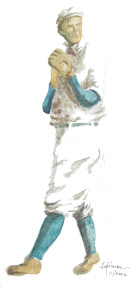
These are probably all terrific books. I have read only one of these books: Frank Deford's book on John McGraw and Christy Mathewson. It was okay though in the end disappointing because Christy Mathewson died early and for some very wrong reasons. He was from all accounts a truly fine person and did not deserve his fate. (BSP alert: The watercolor of him at right can be found at First Inning Artworks.)


But nowhere in the book does Deford really make the case tht McGraw, Mathewson and the Giants invented modern baseball. How could he? It is a ludicrous argument to embark on in the first place.


By the same token, I'm pretty sure that the Scots did not invent the modern world. Don't get me wrong. I love Scotland. I lived their for several months once. At no time did I hear any Scot bragging about inventing the modern world. The Scots do brag about inventing golf. I'll give them that one.

Herbert Matthews, I'm confident, did not invent Fidel Castro. If he did, he has a lot to answer for. The Jews didn't invent Hollywood, Mary Rogers and Edgar Allen Poe didn't invent murder (that one goes to a guy named Cain) and Harold Robbins didn't invent sex. I know I'm on solid ground with that last one.


The only one I'm willing to concede is the last one: Arthur Conan Doyle probably did create Sherlock Holmes.

Because that's what authors do.

Updated May 4, 2008.

Friday, November 21, 2008

Memo to self: Writing projects and beyond


  • SELF-INDULGENCE ALERT: Warning the following is about what I have been up to lately. Not for the faint of heart.
Now that I've ushered one big writing project out the door, it's time to assess and indulge. A couple of things are done, but a couple of others need attention, and some things loom on the horizon.

Writing for the Mass Media. The seventh edition is finished. I put a disk with the supplements in the mail this morning, and soon it will be winging its way toward Boston to await the arrival of the print edition, which will come into existence next month. I never think these new editions are going to require much, and they always turn out to massive efforts.

This book has a lot of meaning for me, and it's hard to know where to start talking about it. Next year will be the 25th anniversary (officially) for the book, and I look upon it as the major scholarly achievement of my academic career. The book has been used in more than 450 colleges and schools in its lifetime. It has been adopted in countries around the world and used as a text in high schools across the U.S. The sixth edition alone was used in about 200 schools and colleges, so it continues to attract adherents.

I have been working on the seventh edition since last spring -- and thinking about it even before then. A new edition of a textbook is a tricky thing. You want to change it some -- add news stuff and the like -- but you don't want to upset the folks who are already using it. So the new ideas have to be carefully considered. Then there's the powerpoints (fortunately, I had a willing grad student do those) and the instructors manual and the web site, which I did myself. The web site isn't up officially, but I have parked it on JPROF.com, so anyone who is interested can take a look.

So, it's done. I'm happy. And I don't want to think about it any more.

After Wallace: The 1986 Campaign for Governor and Political Change in Alabama. This book, co-authored with my good friend Pat Cotter, also has a long history stretching back into the 1980s, and I won't go into that here. The book is on its way to being published by the University of Alabama Press. It is the last hooray for Pat and me and our involvement in politics in Alabama. I left the state in 2003, and Pat will be retiring from the University of Alabama at the end of the academic year and moving to South Carolina with his wonderful wife Barbara.

The book tells the story of the 1986 campaign for governor in Alabama. It was the first post-Wallace era election, the campaign from January through November is a rollicking tale, full of political knife-fights, humor and surprise. It was fun to be there and fun to write about it. The book is full of public opinion stuff, which is what Pat and I were doing at the time. That stuff will make the political scientists happy, but the story itself is the best thing about it.

We sent the manuscript to the UA Press more than a year ago, and the copy-edited pages showed up last week. The Press seems to have an extremely slow process, particularly in light of the speed with which things like this CAN be published these days. Still, Dan Ross, the director of the press, is a good guy and easy to work with. The book should be out sometime next year (maybe).

The Writing Wright. This little book was lots of fun to do and is our test case for viral marketing. Cyn Mobley, publisher and owner of Bushido Press/Greyhound Books, had wanted a small book from me, and I thought this one -- using stuff I had already written plus drawings that I had used elsewhere -- would fit the bill.

"You can order it for $10 from Amazon," I have been telling everyone. "It makes a great Christmas gift."

I'm not wrong about that.

I made pages for the book in Facebook and MySpace, and I even bought a bit of Facebook advertising to see how that works. Those were in addition to the web site I created for it on JPROF.com -- and I am using its title for this blog, too.

A second volume is in the works, possibly for next summer.

Kill the Quarterback. I have wanted to write a mystery novel for a very long time. The trouble was, I didn't know how. Cyn Mobley taught me. She taught me about the difference between story and plot. She taught about three-act structure. She formed a writing group and generously included me.

And, when I finished the book, she thought it worthy enough to publish, so she did it herself.

The book has just come out, and it has just gone up on Amazon. It, too, is a great bargain ($16) and would make a wonderful Christmas present for the entire family and extended family and friends.

The protagonist is Mitch Sawyer, a police reporter for a newspaper in Nashville, who has to cover the murder investigation of a star collegiate quarterback. Mitch is not above conducting his own investigations -- after all, he is a reporter -- and holding back what he has found from the police, even his good friend Detective Tommie Hampton. All that gets him into a lot of trouble, and then he has to figure a way out.

Like I said, a great Christmas present idea, and here's the Amazon link again in case you can't find it from two paragraphs ago . . .

That brings us up to date on the writing projects. What's next? Well, there the second Mitch Sawyer novel that I'm working on. And I am beginning to collect some material for a second volume of The Writing Wright.

Beyond that, I'm not sure.

Another textbook of mine, Journalism: Who, What, When, Where, Why and How, is selling well, and I suspect (fear) that the Allyn and Bacon folks will be around early next year to ask for a second edition of that. The book is 26 chapters long, and that would take a LONG time.


Thursday, November 20, 2008

Cyn Mobley to host Internet radio call-in show on publishing

Best-selling thriller novelist Cyn Mobley will host her first Internet radio call-in show on what it takes to get published on Thursday, Nov. 20, 2008 at 7 p.m. EST at Talkshoe.com.

The link to the show is here: http://www.talkshoe.com/tc/32978

The show is set up so you can just listen in or you can call via Skype or a special phone number:
(724) 444-7444. Those who miss the live show can listen to the archived edition at the TalkShoe link listed above.

"I'll be talking about publishing options, everything from traditional to POD (print on demand) to what's next," Mobley said.

"And you can ask questions or type questions and be as much of a part of it as you want."

Mobley is the author of numerous techno-thrillers such as The Last Casualty and Rites of War. She is also author of the Greyhound Chronicles, which include Greyhound Laughing and Greyhound Singing.

In addition to her own writing, Mobley is president of Bushido Press/Greyhound Books. She has written extensively on novel writing and publishing in the digital age.

The broadcast on Thursday is something new for her. "It's my first time doing it, so we'll see how it goes!"

Monday, October 27, 2008

Elmore Leonard: Rules for writing


  • Lots of people seem to want rules for writing -- as if that makes the process easier. (It doesn't.)
Still, these rules make for interesting reading and are sometimes good reminders. They are the habits that writers should develop. Elmore Leonard works in the genre of fiction, but his rules are worth noting for any type of writing:

1. Never open with weather.

2. Avoid prologues.

3. Never use a verb other than said to carry a dialogue.

4. Never use an adverb to modify the verb 'said'.

5. Keep your exclamation marks under control.

6. Never use the word 'suddenly'.

7. Use regional dialects and patois sparingly.

8. Avoid detailed descriptions of characters.

9. Ditto, places and things.

10. Try to leave out the part that readers tend to skip.

These come from a site called Everything2, which is where a lot of the links above will take you, and there is a short explanation for each if you need explanations or examples.

Leonard likes dialogue to tell his stories and tends to think that everything else is extraneous. Not a bad approach.

Saturday, September 6, 2008

A literary flame who died too soon

Those who die too young provoke particular sadness.

Earlier this summer, we noted the 100th anniversary of the day American letters lost one of its brightest and briefest flames -- Stephen Crane.

Crane's one novel was the Red Badge of Courage, which contained descriptions of the confusion and terror of a Civil War battle so real that veterans of the conflict said Crane got it exactly right. Crane had never been in a battle when he wrote the book. He had been born six years after the war ended.

Crane did see action after the book was published and after he had achieved fame because of it. He took on the role of celebrity reporter for Joseph Pulitzer and the New York World when they were trying by any means to one-up their rival William Randolph Hearst and the New York Herald in covering the Spanish-American War in 1898. The World sent Crane to Cuba, and while he was there, the editors demanded "hair-raising dispatches (and) bombastic scoops on heroism," he said.

The young writer did see action and described it well, even helping fellow reporter Edward Marshall to safety when he had been shot. Crane recorded the last dispatch from the dying Marshall and filed it before he filed his own, which eventually landed him in some hot water with his editors, who accused him of disloyalty when he returned to America.

Crane quit the World and moved to England and continued to write fiction. He had come under heavy criticism from proper Victorians because of his choice of a mate -- a former brothel keeper from Miami who helped him run up massive debts while in Europe. Crane faced a tougher foe than critics or bill collectors, however. He contracted tuberculosis and spent his last months in a desperate attempt to find relief.

That attempt failed, and on June 5, 1900, he died. He was 28 years old.

__________

(Much of the informtion here about Crane's journalism comes from
Denis Bryant, Pulitzer: A Life, John Wiley, 2001.)